Thursday, June 28, 2012

On The Brink of Change: 2012 Farm Bill


Why Food? Seems like a simple enough question, but you will be surprised, hardly anything we see on the shelves of super markets today has any resemblance to actual real food: it comes in vacuumed pack, pre-portioned packages of sterility and convenience. Yet, what does it mean to actually eat food, to touch it, see it, cook it and feel it? We are so divorced from what comes to our plate that we are willing to take produce at face value. Such an attitude leads consumers to settle for food that is Chlorinated and Irradiated, unaware that despite the band-aid sterility such items necessitate toxic treatments in order to render them even remotely fit for human consumption. Small farms are the only real assurance consumers have to assure themselves that the labels present any form of transparency; everything else is a carefully calculated, carefully orchestrated and a highly governed system of smoke and mirrors.
Obviously, the final solution is to buy local, shop at farmers markets, enlist in a CSA programme and shop directly from your friendly neighbourhood farmer. However, this is not as straightforward as one would hope for. The pastures green that once thrived upon the amber waves of grained kissed nation is dwindling faster than you can say recombinant bovine somatotropin.
According to Farm-Aid, 330 American farmers leave their land each week. 330 of the most hard working individuals you will ever have the good fortune to meet are giving up on the only job they have known for 7 days a week, 365 days a year for the majority of their lives. That is 17, 160 individuals per year: an absolutely staggering amount.
Why? Why this mass exodus? What are we doing as a society that would possibly drive -I would consider- the back bone of America out in droves. I will tell you : The current farm bill and the practices it promotes.   
Author Dan Imhoff, “Although the committee proposal includes important reforms to the commodity title, we are deeply concerned that it would continue to give away subsidies worth tens of billions of taxpayer dollars to the largest commodity crop growers and agribusinesses even as it drastically underfunds programs to promote the health and food security of all Americans, invest in beginning and disadvantaged farmers, revitalize local food economies and protect natural resources.” (Food Fight: The Citizen’s Guide to the Next Food and Farm Bill).
Whether you are democrat, republican, moderate or Monster Raving Looney party (for my UK friends) the health of your person, your progeny and your environment ought to weigh heavily on your mind. If you however do not actually give a proverbial you should perhaps stop reading and go crack yourself a Bud and go play beer pong.
In 1933 President Roosevelt passed the Agricultural Adjustment Act in order to help a struggling nation emerge from the Depression by creating policies that aided national issues such as rural poverty and hunger. This was a visionary Bill to rescue agriculture and support a starving nation. So why is it today that we are looking at two major health crises that despite appearing as disparate are in fact interconnected by our current farming policies and legislature?  Food Insecurity and Obesity. Namely, because the Food Bill remains more or less the same as it did 80 years ago, thus allowing for large agribusiness such as Monsanto to maintain an oligopoly on farming, reducing crop diversity and blanketing the landscape with mono-crops such as corn and soy. During the 60’s 70’s and 80’s, the bill provided incentives to farmers to either get big or get out. Small rural farms and agricultural communities were greatly ignored. Unfortunately the current draft of the upcoming legislature leaves the money and the power in the hands of Big Agribusiness.  In 2012, 1 in 7 Americans signed up for food stamps, despite the highest commodity prices in history, rural communities are falling deeper into debt. In 2010 17.8% of individuals living in rural communities were living below the poverty line. In order to feed themselves and their families they turned to cheap highly processed food loaded with high fructose corn syrup and GMO-ed soy.
The monetary proposals of this year’s bill would provide hundreds of billions of dollars per year for agriculture that could, if fairly and wisely proportioned provide the landscape and means that could aid in the obesity crisis, target water pollution from chemical and animal waste run off, prevent the possibility of another dust bowl and support the expertise and ingenuity of a new wave of farmers and ranchers whose land stewardship ideals will benefit future generations.
According to Dan Imhoff and Michael Dimock (president of roots of change and chairman emeritus of Slow Food USA), in order to promote real farming and challenge the Monoculture giants who are destroying our landscape and monopolising good growing and livestock fields with round up resistant mono crops, at least four fundamental shifts must occur:
Supporting Food, not feed. Crop subsidies and federal insurance currently are used for disproportionately favourable to commodity crops used for animal feed, or for to produce over processed food. This leads to a distinct lack of available fresh and affordable produce for most Americans and the likelihood Americans will ingest more packaged food. Combined with a Supplemental Nutrition Assistance Program including incentive programs for fruit and vegetable purchase that would reduce diet-related diseases such as heart disease, diabetes and cancer. Such a program would save trillions of dollars in health cost in future decades.
Focusing on safeguarding the land. As with original bill, government investments should promote the maintenance and good stewardship of the land and waterways. Currently the farm law only supports a minimal amount of requests from farmers seeking to cost share dollars for projects that would protect water and soil quality and endangered species.
Adding labour to the equation. A labour policy to protect the 6 million farmworkers must be implemented. Currently there is nothing in place in the 1000 page document that prevents exploitation of workers.
Increasing research.  The new bill must emphasise the importance of helping food producers and businesses promote practices to end obesity, hunger, water and soil scarcity and species degradation. The bill needs to provide a platform for ingenuity and innovation

The farm bill’s renewal allows such tremendous opportunity to change the face and shape of agriculture. However, the current bill is a dinosaur, a relic that does nothing but support the very factors that are harming our health, or environment and our animals. YOU have the power to change this nation, one food choice, one meal and one vote at a time. Get informed, take a stance and as always instigate some good eatin’ y’all. Always with love THE EPICUREAN. 

Tuesday, June 5, 2012

Greenway Farms


What happens when a sheriff and an attorney retire?  Maybe loll in the florida sunshine, drive an RV across America,  or put their feet up and catch up on all the books they promised themselves they would read but never had the time. For this sheriff, Kerry Dunaway and his attorney wife Robin it was  none of these.  They built a farm - Greenway Farms, in Roberta GA.  Both from farming stock they returned to their roots.  Interesting how that happens! For me I suppose I too have returned to my roots.  My dad was a butcher and a slaughter man and his father was the same and raised a few pigs on the side.  I might not be slaughtering and butchering my own pigs but my heart is in farming.  Add to this my passion, from a very young age, for animal welfare and you have The Activist half of Vital Awareness, dedicated to improving the lot of factory farmed livestock through awareness, and supporting the movement to return to real farming practices (the 'old' ways I guess).  This is exactly what I experienced at Greenway Farms, the 'old ways'.  A small farm devoted to sustainable and humane methods of raising animals and crops - the Dunaways know that you only get out what you are prepared to put in  - that's why they are a zero waste farm, what comes from the land goes back into the land with a lot of help from their vermiculture - the worms.  The Dunaways make a wholesome compost, with a Canadian peat starter, worm fodder, fruit and vegetable snacks, and some scraps of newspaper for a worm treat (kinda like the equivalent of worm twinkies)...and of course lots of worms and patience.  It will take about 12 months for the worms to eat their way through the organic matter in their bed and poop it out (I think thats how worms make compost!)
So what do they do with their compost  - grow a wonderful array of vegetables which the Dunaways eat, sell, and 'can'.  The runts of the veggies go to the livestock and...you guessed it to the worms too (a picture perfect cycle).  
Even the local Piggly Wiggly is on board  - instead of throwing the over-ripe un-sellable fruits  and vegetables in the dumpster they donate to The Worms of Greenway Farms. In fact such is the contribution that the Dunaways have a page on their website in honour of Piggly Wiggly.  The Dunaways are in the process of building up their livestock.  They have poultry and laying hens, meat goats, and pork. Unfortunately I didn't get to see the pigs as they were already in Greenway customer freezers - however I did get to see the three acre woodland that these pigs had had all to themselves to forage root and do whatever it is that pigs should be doing.  The hens have plenty of pasture and are the perfect definition of what it means to be free range.  We have touched on labeling and how misleading it is (deliberately so)  - we will cover it in more detail in a later blog.  So back to the free range chickens, as Kerry put it "these hens could catch a bus up to Atlanta for food if they wanted to" - but as I said they know which side their bread is buttered and have no intention of moving to Atlanta.
Currently the Dunaways are building what is for them the perfect herd of goats - how are they doing this? The old-fashioned way of true animal husbandry.  They are breeding from the does and selling on the bucks, and through selective breeding are creating the characteristics for a herd that will suit their needs, farm, customers and geographical position.  When I say this is a no waste farm I truly mean it, there is usually milk left over by the breeding does after they have fed their young - I am  sure a good deal of it makes its way to the Dunaways table but the superfluous gets made into handcrafted soap.  Oh and one more thing, the farm has a sawmill operation (the office and mobile hen house were built from the lumber on Greenway Farms) and the left over odds and ends of lumber are burned and the ash spread on the farmland and pasture as a potash fertilizer.  
The Dunaways are working with other small farmers to get a chicken processing facility built, so that as a co-operative they can share the costs of building and the over-heads of running a processing plant.  This means that chickens will be raised, slaughtered and processed within just a few square miles - this is very exciting for the small poultry farmers in middle GA.  This leads me to the topic of the BIG poultry producers of N Georgia - we know who they are! The Dunaways are keen not to head-butt with the industrialized chicken producers because in any head-on fight there will only be one winner and it won't be the small farmers eking out a living from the land.  
As we at Vital Awareness contend (and I believe that the Dunaways are in agreement) the only way to change the supply is through demand; we have to get consumers to vote with their food dollar as to how they want their food to be produced, so that we can move away from factory farming and get the animals off the concrete and onto the pasture.  How do we do this? We can do it through awareness on four fronts thereby harnessing most consumers (depending on their concerns) - one: pasture raised meat tastes better, two: its better for one's health, three: it is better for the environment, and four: (in particular for me The Activist) from an animal welfare point of view it's the only humane method of raising livestock destined for the food chain.  
TOGETHER - the real farmers and the consumers can make a difference; collectively we can change the face of the food industry - but ultimately the buck literally ends with the consumer, without our help the real small famers of the U.S.A. don't stand a chance.


Sunday, May 27, 2012

The Stockman: Redux


You may recall from a previous blog, my wonderful counterpart – the ACTIVIST- ventured over valley and dale to the back roads of Georgia in order to pay a visit to a man whom we count as an ally to Vital Awareness: Mr. Will Harris and his agricultural promised land White Oak Pastures. The praises and exultations she sang were nothing short of reverent. This of course meant that the cynic in me – damn you philosophy degree- had to see this for my self in order to make sure the glasses through which she viewed were not simply rose tinted.

A few weeks ago, I too prevailed the same terrain – with Gillian in toe- and was overjoyed in the discovery that the glass was crystal clear. Will and White Oaks Pastures is everything it is cracked up to be. I was greeted by a man whose demeanour was nothing short of radiant; a good ole boy with a heart of gold possessing a spark of piss, vinegar and ethic of hard work and firm love. Not bad for a first impression, eh?

Will is a gem of a man. Thus, since Gillian provided you with information about the operation of White Oak Pastures in such masterly detail I shall endeavour to conduct this blog upon a more personal level and talk about Will the man and the farmer, as it is his spirit that is the driving force behind White Oaks.

After exploring the new organic garden and both the Beef and Poultry processing plants –including the killing floor, an environment so efficient and sterile it was hard to believe it had been utilised only a day before- we clambered into Will’s trusty jeep and set off to venture the bountiful acres of the farm. The land that comprises White Oak Pastures is compelling. Will has ensured the environment is given full reign: nature is, as it would appear, as nature does.  What White Oak Pastures, and what Will subsequently stands for, is an affront against Big Agriculture, where the unfortunate majority of our current meat and dairy supply comes from. White Oak Pastures meat can be purchased and enjoyed at Whole Foods, Yeah! Burger, Buckhead Beef and Publix. White Oak Pastures is a model that stands up to Tyson, Perdue and Smithfield (the largest meat suppliers in the industry) and doesn’t only play with the big boys but can give them a run for their money. White Oak shows that common market consumption doesn’t mean cutting corners on environmental, worker or animal welfare. Instead, it is possible to produce on a commercial scale and still maintain the utmost of integrity: and that is why Will is my own personal hero.

So back to Will the man and the rancher. Why I love Will Harris is, that despite his confidence and charm, the humility towards his animals and the environment is apparent right out of the gate. He is a man who is not afraid to testify his weakness at the feet of Mother Nature. Passing the chickens- squawking, pecking and scratching at their leisure- I noticed a group of hawks circling scanning the field for a meal. I quizzed Will as to his stance on this and his reply floored me. I should probably tell you that Will isn’t some city slicker like myself wanting to rough it and make good, he is a famer from way back. His pappy and grand pappy and great grand pappy were all farmers, he knows the drill and he knows the trends and he ain’t ashamed to admit he is a “good ole’ boy from the south”.  However, during what Will describes as a midlife crisis of sorts he woke up to the realisation that perhaps the way he was doing things, they way his father and grandfather did things and the training he received through the UGA animal husbandry program, just didn’t feel right somehow.

This wake up call prompted him to radically change his farming practices… although Will admits it wasn’t all smooth sailing. Like anyone who suddenly has a eureka moment, one has a tendency not to think things through and Will was no exception. Apparently, it isn’t quite as straight forward as releasing the herd onto pastures green…especially when there isn’t much green there to start with. Thus began a long struggle with assimilating the herd and a nasty battle with Nitrogen Phosphate addiction – thankfully Will has been in recovery for a while now- as Will battled to move away from a lifetime of conventional agriculture and animal husbandry http://www.youtube.com/watch?v=x8ccDb6n5Wg&ob=av2etowards what he believes -and what proves to be- the only form of farming that truly stands for sustainable and ethical practices.  Yet, Will prevailed. He stuck to it and admits that farming is and always has been a journey and not a destination. After establishing his herd and his farm, Will began to bring more animals into his proverbial fold (pun intended).  Will practices the Serengeti method of farming: his pastures consist of large ruminants (cows), smaller ruminants (sheep and goats- the goats are a bit of a bug bear for our good friend: twice we were forced to begrudgingly herd them back into there assigned pasture; I suppose that is what happens when there are no fences) and fowl.  As the larger ruminants are moved to another pasture, the smaller come and graze on different grasses and then finally birds and fowl feed off the bugs and insects that remain. It is a rich and simple method of farming inspired, obviously, by the harmony of the African grasslands and the only method of livestock farming that Will would ever consider practicing.

Will has received a lot of flack for his growing selection of livestock. Folks misunderstand his intentions it would appear, chalking his enthusiasm toward increasing species variety to greed and a way to get his fingers in more of the proverbial pies. Now, don’t get me wrong, Will is a business man and is doing this for profit, but that is not why he chose the Serengeti method as his desired method. Will has a deep respect for his animals, the environment and the often times brutal truth of the natural order. In fact he stated that he would sooner go back to using chemical fertilizers before he would even consider reverting to mono-culture farming, and he ain’t gonna do that anytime soon!

Like I said before, Will –despite his larger than life personality and wit- has a deep humility for enormity of nature.

So back to Wills answer regarding the hawks and as to whether he worried about predation? His answer was that of a man with a profound respect for the omnipotence of the earth. Some chicks and chickens will be taken away by a hawk, but Will believes and hopes that those that do were weaker and perhaps would not have survived anyhow. He has this same faith when it comes to his waterfowl and the ‘gators who reside in the murky depths of his on site lake. For Will, Hawks aren’t his biggest problem; Hawks kill one single bird at a time, whereas the Coyotes who prowl the outskirts of the farm kill indiscriminately hence his need for the Great Pyrenees lounging the fields. The beautiful Great Pyrenees are a more preferable option to traps and guns.

Never have I had the good fortune to meet a man who has the deep appreciation and empathy towards the natural order. To talk with Will is to talk not only to a bastion of farming but a warden of the earth. Will works to maintain harmony with nature and honour her power.

Vital Awareness has no bigger advocate than Will Harris, and in turn he has no stronger supporter than Vital Awareness.  He his a man I hold in no higher esteem. When Farmer, Foodie and Vegan can work together in a cause that has such an impact on the welfare of this planet and its inhabitants, well it’s a beautiful thing baby!

So, shop ethically, shop mindful and do me a favour: give Will Harris a call. In short, stay true, stay real and stay humble… cos its all about good eatin’ y’all.

Love always THE EPICUREAN

Thursday, May 3, 2012

Action Alert for Organic Standards

 Below is an action alert newsletter from the Georgians For Pastured Poultry - we need to take action to improve the organic standards in the U.S. - please read this and sign the petition which will go directly to the NOSB (National Organic Standards Board).

Action Alert!
Behind closed doors, the world’s two largest organic markets have entered into an ‘equivalency agreement’. This so-called equivalency means that organic farm animal welfare products from the US can be sold as organic in the EU, and vice versa.

What’s the problem? Put simply, they are not equivalent. As they stand, US organic standards fall far below standards with regards to animal welfare when compared to EU standards. The US standards as they stand allow practices that would not only be non-organic in the EU, but would in some cases actually be illegal on welfare grounds.

How can this be ‘equivalent’? We must take action. In a matter of weeks this agreement will come into effect.

This is a major setback for animal welfare around the world. However, there is the chance we can turn it into an opportunity. to make a difference. At the end of May, the US National Organic Standards Board (NOSB) will be discussing revising these standards. We must urge the NOSB to raise the US standards to make them truly equivalent to EU standards. They need to put farm animal welfare first.

Compassion in World Farming will be there to urge for higher animal welfare standards. We will be demanding that urgent revisions be made in order to meet consumer expectations and farm animal welfare needs.

You can help us:
*   Please submit comments online directly to the NOSB voicing your concern by May 3. Ask them to strengthen the species specific guidance documents for assessing animal welfare. You need only complete the “required”fields on the contact information form and enter “citizen” in the Organization Name box.

Sample Comment:
     I am writing to comment on the Livestock Committee’s proposed guidance documents forassessing animal welfare. While we appreciate the efforts that have been made to date, we would like to strongly urge the Committee to continue its efforts of improving the standards so that they meet up to expected standards for organic production and indeed meet up to recognized good farm animal welfare practice.
     We are deeply concerned with regard to the recent equivalency agreement between the EU and the USA regarding organic standards. There are some very significant differences between the EU and USA organic standards with regard to farm animal welfare as the standards currently stand. While we appreciate improvements are being proposed,  USA organic standards with regard to farm animal welfare are by no means equivalent to the EU organic standards as they stand.  EU consumers will be very concerned when this comes into effect in June and may as such largely reject US organic farm animal products until they are truly equivalent.
     With this in mind, we urge the committee to continue to work to revise the national organic standard in order so that they meet farm animal welfare needs and the expectations of consumers.


In addition to the revisions that have already been recommended, we ask you to include the following in the guidance:


1.  Minimum indoor and outdoor space allowances for turkeys, geese and ducks should be increased, and geese should be given access to adequate water for bathing and head dunking.
2.  The guidance  should recommend gas stunning over electric stunning for poultry to avoid removal from transport crates, shackling and inverting of conscious birds.
3.  For the weaning of sheep, guidance should raise minimum weaning age to 45 days; current limit is 5 weeks (35 days). Weaning of bison should preferable be natural, or as a minimum 3 months of age.
4.  Sheep should not be allowed to be transported before one week of age.

Making these modifications will increase animal welfare and help bring the care of animals under the organic program closer to what consumers expect of the label, and closer to achieving true equivalency with EU standards.

To submit your comments online, click here.

Please share this with family, friends, and co-workers, and encourage them to submit a comment, too. Thank you!

~ THE ACTIVIST

Thursday, April 26, 2012

West Wind Farms


One evening in the Tennessee hills a good 15 years or so ago Kimberlie and Ralph Cole were sitting on the porch of their newly acquired farmhouse surveying their land - one hundred acres of pasture, scrub and trees; a strong wind was blowing in from the west and at that moment West Wind Farms was born.
Exciting as this was, trepidation was not far behind.  Both Kimberlie and Ralph had  'day jobs' as environmental research scientists in the city of Oakville and here they were out in the boonies of TN about to embark on a life altering journey.

Photo from West Wind Farms' website
 West Wind Farms is set just outside Deer Lodge TN and according to a historical description of the town "The climate is charming. The water is pure and soft [and]...The wild lands are covered with an indigenous grass on which, cattle, sheep or horses thrive and fatten". 
...Perfect farming conditions.

The prompt to buy the farm and land came from a realisation - that working to earn money to pay the bills and buy life's essentials seemed to be an inefficient way of living - it began to make more and more sense to cut out the middle man, as it were, and provide their own necessities.  So...some land to grow vegetables and to graze livestock were what they needed, and this led them to cashing in their nest egg and buying the farm that has now become their homestead, their livelihood and their lifestyle.

Both the Coles maintained their jobs and spent a few gruelling years juggling jobs, farming and commuting, often getting by on only a couple of hours sleep.  I am sure there were many moments when nature didn't cooperate, when sleep seemed like a far distant dream, when animals were sick and needy, when they were scraping the bottom of the financial barrel, when their fixer-upper farmhouse was not getting fixed up that they thought "what the heck were we thinking of..."

But hard-work, sheer determination and their vision kept them going.  
They grew a few crops and vegetables to eat, raised chickens for meat and eggs, and kept a cow or two for milk.  After a while they were producing more chickens than they could eat and began selling their chickens to neighbours and friends in the locale.  It turned out that their chicken was really good and their small customer base just couldn't get enough. It seemed like they were rearing and producing  quality food and perhaps could eventually make a living out of this!! 
Their professions equip them to make use of the geology of the land and environmental resources, and it transpired that a wonderful geological nugget came with the land  - the mineral rights to a natural gas source.  What could be better for a couple of environmental scientists?  So harnessing their natural gas and solar power, West Winds is now almost energy self-sufficient.  I must admit for me it was a first, and a most impressive experience being taken on a farm tour by Kimberlie in their natural gas powered farm truck!  The Coles are thrilled that they can make their sought after deliveries and trips to farmers markets without making a dent in their carbon footprints.

So to the animals - pigs, dairy cows, beef cattle, sheep and chickens - all pasture raised in the Tennessee hills.
What at first seemed a daunting amount of land for the Coles to tend and care for is today simply insufficient for their needs and they have acquired extra pasture over the years. Some of which they have purchased, some they rent, and the remainder is on loan from the generosity of neighbours who allow them to share parcels of their land for pasturing their animals. And today the hogs have their own 100 acre wood for foraging and routing.  
As a testament to their commitment, efficiency, and responsible use of land and resources the Coles are able to keep a steady supply of meat flowing into markets in and around Tennessee.  From what I understand the farm is ready to expand into larger markets but is not being given the opportunity - I hope that opportunity comes knocking soon!
West Wind  produces excellent quality pork, beef, lamb, chicken, and milk. Currently there are 26 Jersey dairy cows on their farm, and as well as being the biggest producer of raw milk in the state (through the 'pet' milk and the cow share laws) WWF is also a producer of quality A2 milk, and its amazing how many wholesome pints one can get out of a small pasture raised herd. There is controversy around the healthy and unhealthy aspects of milk.  Milk in its raw state contains the most usable form of protein and minerals which have not been altered or destroyed by the intense heat of pasteurisation - the law varies from state to state as to the permissible retail sale of raw milk (this Raw Milk 'Map' was last updated in 2010 and I am assuming is still current).  But to add to that the talk now seems to be about A1 versus A2 milk!!  In a nutshell, A2 milk is considered better for one's health than A1.  The former comes from the older breeds such as Guernsey and Jersey cows, the latter from Holsteins - unfortunately Holstein milk is the most prolific in the U.S. because Holstein's are big milk producers: in other words you get more milk per pound from a Holstein than a Jersey. So if you aren't able to get raw milk or the thought of drinking unpasteurized milk scares you then I guess you should make sure the milk you drink is the A2 variety.  Guernsey cow's milk is the highest in A2 proteins, and Jerseys come in next.  There doesn't seem to be a lot of talk of it in the U.S. but check out UK and Australian websites if you want more information, or read my up-coming Dairy Blog.
 I keep going back to this point...but from a personal standpoint, for me THE ACTIVIST, the jury is still out as to whether the dairy industry can really be considered humane in view of the fact that the calves are taken away from their mothers within days or hours of being born.  This is a cyclical trauma for the cow and you can read about some of my concerns in my blog on Sweet Grass Dairy. I have been promising a dairy blog for a while now - honestly I will get to it, I just need to do more research (and a bit more soul searching, I guess).  Ralph Cole explained that at West Wind Farms they have tried various methods of breaking the cow/calf bond and in their experience they felt that the kindest 'cut' was to remove the calf within a few hours, rather than leaving baby and mother together longer than 24 hours.  But all that being said I believe that the dairy herds like those at Sweet Grass Dairy and West Wind Farms are treated as humanely as possible under the constraints of operating a viable dairy business.
WWF is a closed farm  - this means that the animals are born on the farm and stay on the farm till they die - of old age for the breeders/milkers/layers or taken to slaughter for the meat livestock.  Which brings me to another point - slaughtering. I have already touched on the inadequacies and often abusive conditions in USDA approved abattoirs in my blog on White Oak Pastures: The Stockman and The Vegan,  and the Coles (I am assuming sharing concerns similar to mine) have, after careful research, been unable to find any processing facilities in Tennessee or neighbouring Georgia that meet their high standards for slaughtering and processing.   Currently the chickens are taken to an Amish abattoir in Illinois a couple of states to the northwest, and the rest of the meat livestock to a facility in the neighbouring state of Missouri.  This is a sad reflection on the state of the slaughtering facilities in the U.S., no matter how humanely a farmer raises his livestock the end is for the most part out of his or her control;  and for the animals in many of the slaughter facilities in the U.S. it is often undignified and frequently cruel (and yes...if I can face it, a blog on the inadequacies of slaughter-houses will follow).  

West Wind Farms meat is available online, farm pick-up, Farmer's Markets in Tennessee and North Georgia, and 22 'host homes' - all the relevant information is available on West Wind Farms' website. We first came across WWF meat products last season at the Brookhaven Farmer's Market in Atlanta and we are happy that it will be available again this season when the market opens on May 5th.

As you will see from West Wind Farms' website although not yet available in 'mainstream' markets it is not too difficult to obtain their products and sample their delights.
Vital Awareness' visit to West Wind Farms was a rewarding experience: West Wind Farms is a wonderful model of what it means to practice humane and truly sustainable methods of farming, whilst maintaining an excellent quality of meat.  ~ THE ACTIVIST

Wednesday, April 4, 2012

"...lay a little egg for me"

I have often dreamt about waking up to the sound of the
cock crowing, and scrambling some eggs laid by either "Rosie" or "Ethel" who live in my back yard, with maybe a drop of milk from "Daisy" the cow or "Sally" the goat - a dream of pastoral bliss.

Today my story is not about Daisy and Sally, their story will come later, but about Rosie and Ethel the hens (who in my scenario of pastoral bliss are the lucky ones) and their 280 million cousins living in the U.S. (who are not so lucky).

This story begins with "the birds and the bees", and a brief overview of the what, why, and how of eggs.  An egg is a hen's external ovulation and whether it turns into a chick depends whether it is fertilized by a cock ('rooster'). So generally speaking if you are keeping hens for eggs you need to keep the cocks well out of the way until you want some babies.  A hen does not necessarily lay every day and, without going into too much detail, the frequency of laying is due to the time it takes for the hen's yolk to make its way down the oviduct, go through the various processes of being encased in its protective membrane, and finally enclosed in its hard shell before it is laid.  As a guiding average a hen will lay two eggs every 3 days so that's why you need a few hens if you want your daily scramble.  A hen likes to lay her eggs in 'clutches' (batches) and clutch sizes can vary on average from around 12 to 20.  In the natural world a hen will become broody when she has sufficient eggs in her nest and will sit on the clutch to incubate the eggs, whether they have been fertilized or not.  Some breeds get more broody than others and farmers will discourage an overly broody hen as she will not be an efficient layer. On the flip-side of the natural v. unnatural world: as a consequence of genetic engineering in industrialized farming, 'factory' hens have had all the broodiness engineered out of them.  As a farmer friend said to me recently, chickens in factory farms don't know how to be chickens any more.
Now, from time immemorial farmers have been practicing selective breeding and cross breeding to produce the best hybrid hen that is a great layer, adaptive to its climate, and a good forager (this keeps the food bill down and the hen and her egg healthy) - this is part of animal husbandry. Farmers and backyard chicken raisers have used many methods to increase and maintain a good yield of eggs.  Going back to our hen biology lesson: egg laying is part of the reproductive system and is therefore stimulated by hormone levels; hormone levels are influenced by the pituitary gland (the master gland), and the pituitary's efficiency is stimulated by sunlight -  so to cut to the chase - the more daylight a hen gets the more she will lay.  This means that in the summer her laying is higher than in the winter months when the days are shorter. Farmers have been manipulating this fact for decades to ensure a steady annual flow of eggs and have provided 'daylight' lamps in hen coops, probably since the invention of electricity.
A hen's diet is important for peak health and peak laying conditions and she is an omnivore by nature, and will balance her diet naturally when she is allowed to forage, scratch and peck for grass and insects...and all the stuff that the bigger foragers leave behind.  Depending on the quality of the land and time of year, pasture raised hens may need some chicken feed - but this is supplementation and doesn't constitute the full body of the birds' diet.
So we can see that to get the most desirable qualities out of his hens a farmer has a few tools at his disposal.  He can pasture his chickens thereby keeping the chicken food bill to a minimum, rely on selective/cross breeding to produce a chicken that is going to be a good layer, maintain 14 hours of daylight year round to ensure a more consistent supply of eggs, and most importantly be cognisant of the health and welfare of his birds.
A humanely raised hen will provide a good number of eggs each year - 200 -300.  Just a few chickens will provide a daily egg or two, enough for friends and family, and a decent size flock will ensure a commercially viable egg business - all from happy hens.

Now over to the industrialized cousins, the breed known as "the layers".  A very different story (and a very different egg).
The factory-farmed layer has a more miserable existence than its industrialized counterpart - "the broiler"  - impossible as this may seem (check out the plight of the broiler chickens in "Finger Lickin' Good")
So how can this be?  Answer: the hens in the egg industry are simply vessels for the final product - their welfare is of absolutely no importance, and veterinary care is non-existent as the birds are cheap and expendable.  "They suffer from blisters, tumors, foot and leg deformities, Fatty Liver Syndrome, Swollen Head Syndrome, heat stress, mold toxins, mouth ulcers and many other diseases. 

Birds too sick to lay eggs are thrown onto the "dead-pile" and sometimes in the manure pit - dead or alive.
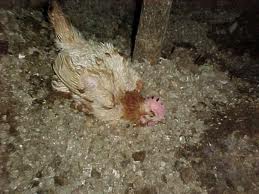
Currently there are more than 280 million laying hens in the U.S. living in these unsanitary, inhumane and cramped conditions inside metal cages; ninety-five percent of the eggs available in the U.S.  come from these "houses of horror".  Hens are squeezed between four to six in a cage, with each one recieving a space just half the size of an A4 sheet of paper.  The hens stand on the thin wire of their cages their whole lives, the metal often cuts into their feet and it is not uncommon for their claws to grow around the metal wire.  The hens can barely turn around and certainly cannot stretch their wings, and they must stick their heads through the wire mesh of the cage to reach water and feed. The cages are stacked one on top of each other and their bodily excrements pass through the cages into manure pits at the bottom of the tiered cages.
 Toxic ammonia fumes rise from the decomposing uric acid in the manure pits beneath the cages resulting in eye problems and chronic respiratory disease in millions of battery hens, and from a human health standpoint studies have shown that even at low concentrations significant quantities of ammonia can  be absorbed into the egg. A day in the life of an industrialized laying hen is the same as it was yesterday and the same as it will be tomorrow - cramped, uncomfortable, boring at best and excruciatingly painful at worst.
 A Day in the Life of a Battery Hen: "It is summer, and the hen feels too warm, and uncomfortable. Her instincts tell her to scratch out an area of fine, dry soil and dustbathe in it to keep cool. She is so desperate to do this that she goes though the motions on the bare wire floor of the cage lying on her side, scratching the cage floor, rubbing her head and neck on the floor, opening her wings and damaging her feathers. But she cannot dustbathe, so she simply pants to dissipate heat and takes out her frustration on her four cage-mates by pecking them" -
Naturally the hens become bored and aggressive - who wouldn't - cooped up in claustrophobic cages; and so industrialized chicken producers have chosen to minimize the problem of fighting by debeaking and toe trimming.
These mutilations are carried out without the use of anaesthetic and are extremely painful procedures for the chicks, and the birds continue to suffer pain and problems with their shorn beaks for the remainder of their lives.
A factory farmed hen is genetically engineered and environmentally manipulated to lay many more eggs than nature intended. A hen starts life with all the makings of thousands of undeveloped eggs inside her body - more than she will ever lay: (now, to my unscientific brain, I wonder - is this is one of the aspects of hens' biology that the scientists harness when they genetically engineer hens to lay more than they would in natural circumstances?)  Whatever/however, it goes without saying that this excessive laying creates untold hardships on the hens. Shells are made up of calcium which the hen provides from her skeleton, but her expenditure of calcium far exceeds her 'income' and factory farmed hens suffer from osteoporosis, with their legs becoming "so brittle they snap like twigs".
When a hen's egg production slows down it is often forced into a laying bonanza through a cruel system known as 'forced-molting'. A system so cruel that it has been banned in most European countries for the last twelve years. To explain what forced-molting is I need to go back to the biology lesson.  Like other birds the hen goes through a molting period once a year. During molting the hens will stop laying, then, when the lost feathers have been replaced the hen will resume laying with vigor. So industrial chicken producers capitalize on the post-molting period by tricking the hen's body into a non-seasonable molting through manipulating her hormones. How do they do this? Answer: through food deprivation (average 12 days) and water deprivation (3 days - any longer and they would die).
 The vigorous post-molting laying eventually slows down and so the hen can be put through this procedure more than once until the producer is sure she is spent, then she wil be slaughtered and what little flesh is remaining on her frame will most likely end up in baby food. Needless to say 'forced-molting' causes tremendous stress and suffering for the hen, and the United Poultry Concern has campaigned long and hard to get a ban on this practice. Fortunately the USDA has enforced some changes to this practice, but unfortunately these changes have not gone far enough - rather than being completely starved the hens are now semi-starved through an administration of minimum amounts of nutrients and a little water. Still extremely undesirable but hopefully a step in the right direction toward a total ban on the practice.

As I pointed out earlier a hen's laying cycle is dependent on daylight and  farmers provide lamps to maintain 14 hours of daylight steadily throughout the year to maintain a regular supply of eggs.  Being concerned about the welfare of the hens we asked Matthew O'Hayer from Vital Farms how demanding was this 'year-round summer' to the hens. He assured us in an email that from an "animal welfare standpoint...I have not observed a difference between hens that are provided with supplemental lighting and those that are not...Also organizations like Certified Humane and Global Animal Partnership...have not noted any issues pertaining to such small amounts of extended lighting".  During the hours of darkness, the hens reproductive system slows down and results in the average 2 eggs every 3 to 4 days that I mentioned previously.
The difference for factory-farmed hens is that for them the lights never go out, and the hens' "reproductive organs [are] ravaged by the continuously burning light bulbs in the [sheds] to which hens' bodies respond involuntarily by trying to form eggs [in this permanent 'daytime']" - United Poultry Concerns.

Have you ever wondered what happens to the male chicks that are born in the industrialized egg industry? Only a very small number are needed for their semen supply; so being superfluous to needs, day old male chicks are thrown live into a grinding machine and macerated for fertilizer (picture a wood chipper and you get an idea), or else they are dumped into plastic bags and allowed to die of suffocation or dehydration in dumpsters.

Leaving aside the animal welfare aspects of factory farmed 'layers' for a moment,  what about the end product of all of this - the eggs themselves?  Eggs have been given a bad rap over the years because of their purported high cholesterol content, however, eggs produced by naturally pasture-reared hens are healthy and have the right balance of the essential fatty acids of omegas 3 and 6. The health problems arise from eating the unhealthy eggs produced by hens raised on unnatural diets in an unnatural habitat. Factory eggs are much higher in omega 6 and because the Standard American Diet is already too high in omega 6 (15-20 times higher than it ought to be) there is a serious imbalance that can lead to heart disease, high cholesterol, and many of our degenerative diseases.

So whatever our concerns are - animal welfare or a quality product - we have to change the way our eggs are produced. So what can we do to help change the face of the egg industry? Change begins at the grass roots level with the consumer.  Consumers can demand ethically and humanely raised eggs with their food dollar by buying pasture raised eggs from supermarkets and farmer's markets. Consumers need to get to know their local egg farmer, research egg suppliers and find out the farmers/producers who are pasture raising their flocks sustainably and humanely.  This information is available from websites such as Animal Welfare Approved,   Eat Wild,  American Grass Fed,  and Local Harvest.  One national supplier who has a top billing from the Cornucopia Institute and Wholefoods 5-Step Rating System is Vital Farms. Whenever you see Vital Farms stamped on the egg carton you can be rest assured that you are buying a quality product that has been humanely and sustainably produced.
Buy pasture raised eggs, and support animal welfare groups such as Compassion In World Farming and  Vital Awareness to help us in the campaign to change the way our food is raised and produced.

Producers such as Vital Farms have proven that ethical, humane and sustainable egg production on a larger scale is possible, and can still be a viable and profitable business. With the right farming practices everyone and everything benefits - from the farm animals to human and environmental health.
Make sure that your morning 'sunny-side up' is truly the sunny-side up.

                                                                                                                                 - THE ACTIVIST